Voice identity
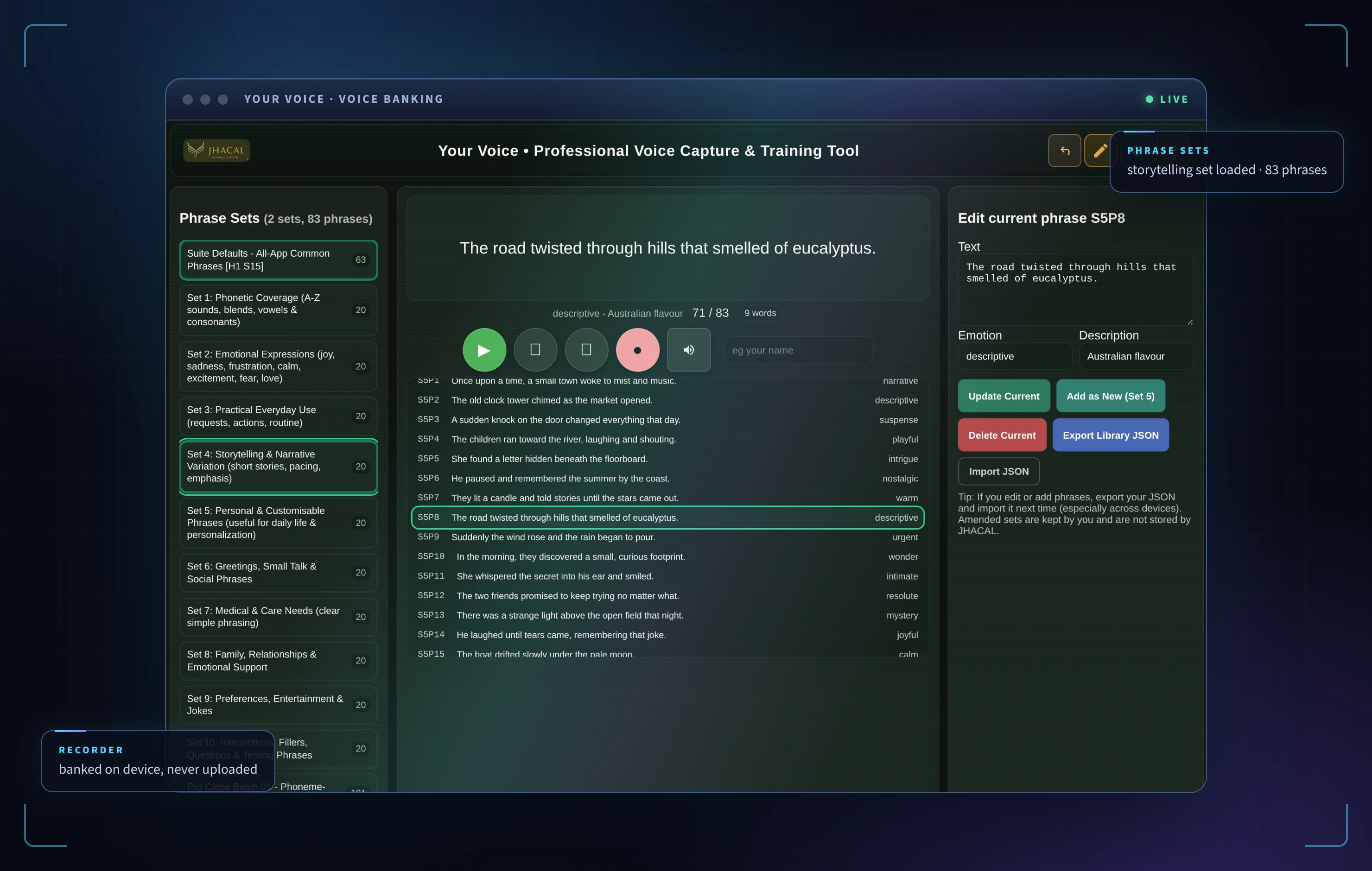
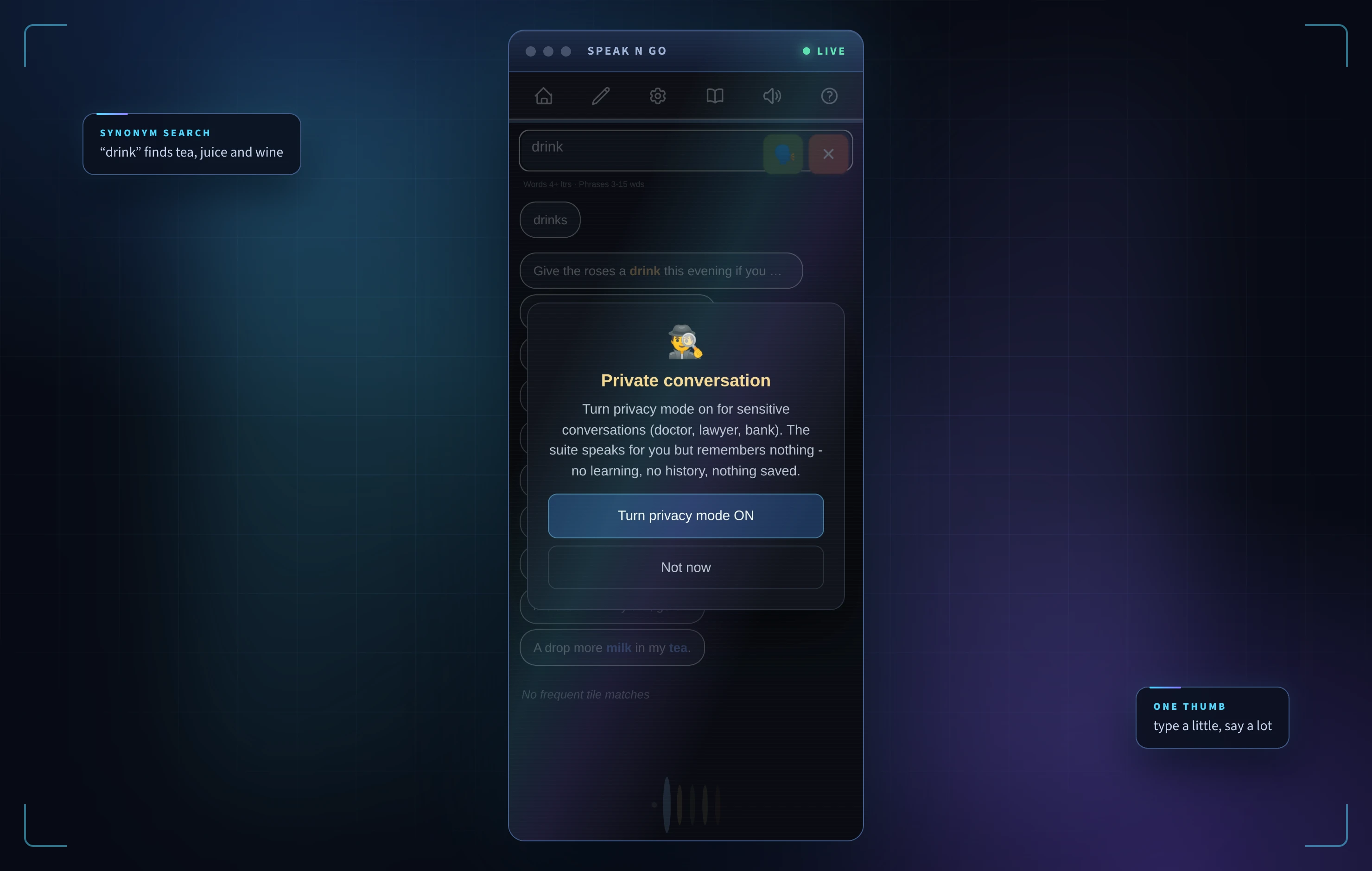
Bank your own voice while you can, or build a clone of it, ElevenLabs-style, so what you type sounds like you. Cloning is strictly opt-in and consent-based: your recordings, your control, used for no one and nothing else.
Next-generation augmentative and alternative communication
State-of-the-art text-to-speech, deep personalisation and on-device memory, wrapped in an interface anyone can use on their hardest day. Simplified on the surface. Complex in the architecture.
Start your free demo See the architecture
Free lifetime demo for end users. Register for updates. No card details, ever.
Why AAC matters
AAC is not a niche. It is for the singer on vocal rest, the teacher with strained cords, the patient recovering from surgery, and the person whose speech is changing for good. The numbers say it plainly.
Australia, where we build
About 1.3% of Americans cannot reliably meet daily communication needs using natural speech.
US National AcademiesThe UK estimate of people who may need AAC, used to plan specialist services.
RCSLTUS adults report a voice problem every year, around 17.9 million people.
NIDCD / The LaryngoscopeTeachers report voice disorders at nearly twice the rate of everyone else. Heavy voice use, including singing and childcare, is a known risk factor.
Roy et al., JSLHRTemporary, situational, progressive or permanent: when speech is out of reach, everything else gets harder. Speak Easy Suite is built for all of it.
How it works
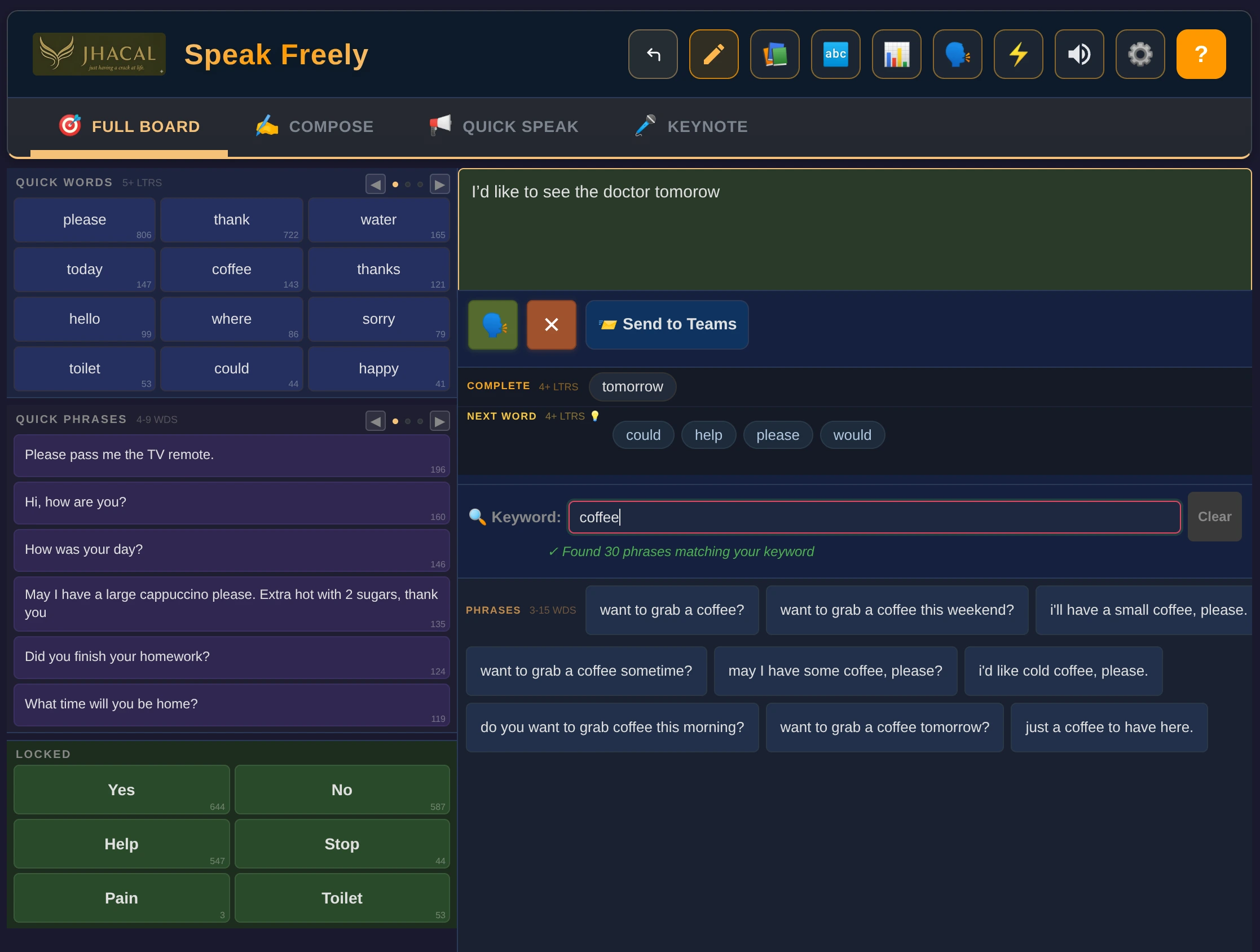
On screen, it is a calm board of words and tiles. Beneath it, a private language engine is learning how you speak, ranking what you say, and keeping every word on your own hardware.
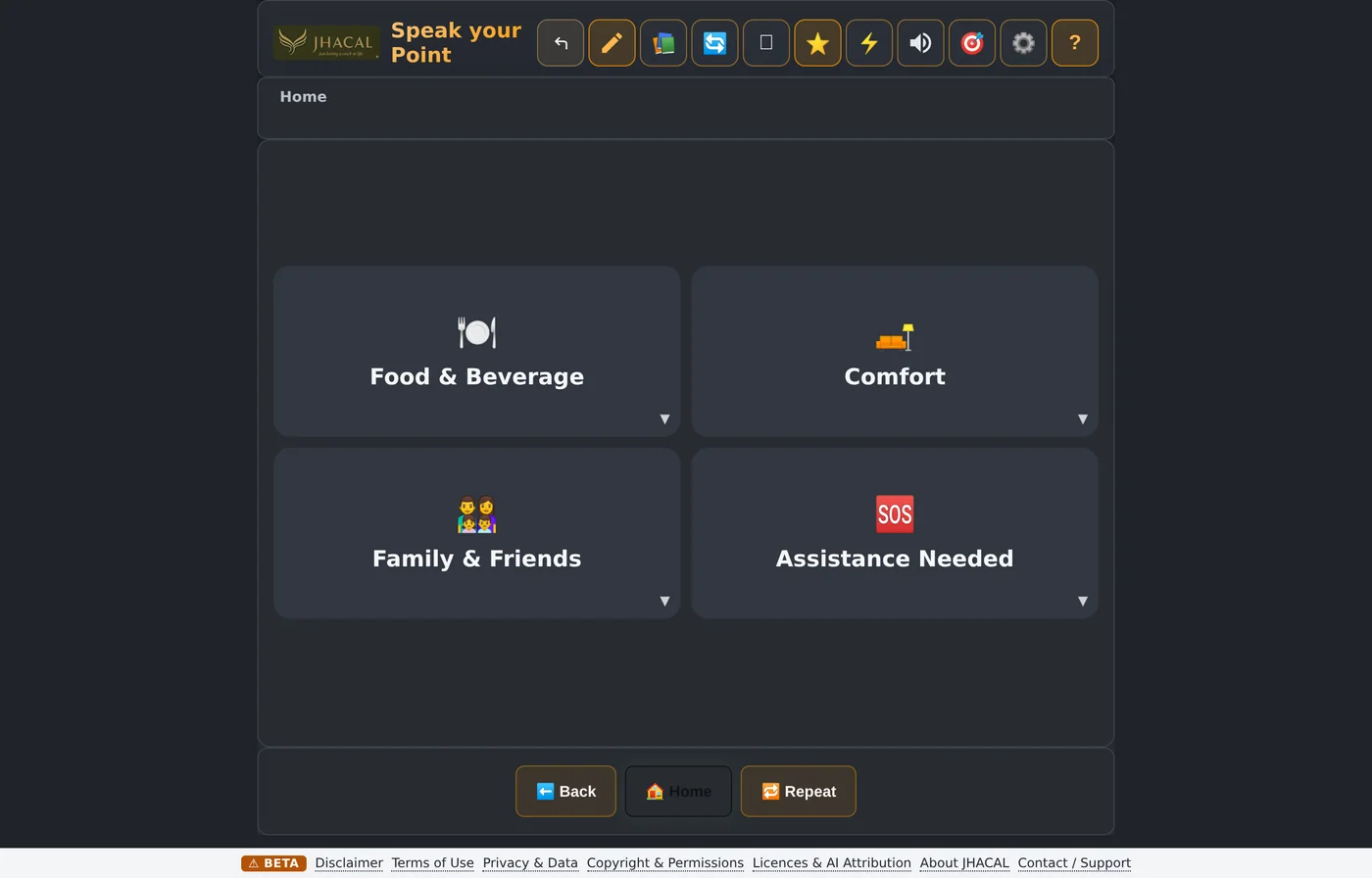
Nine tools, one design language. Big targets, instant speech, zero manual.
Prediction, phrase ranking, vocabulary and tone shaped to one person.
Every word and phrase, when you last said it and how often. Never uploaded.
State-of-the-art text-to-speech, tuned for rate, pitch and clarity. Or your own recorded voice.
The part almost nobody else does
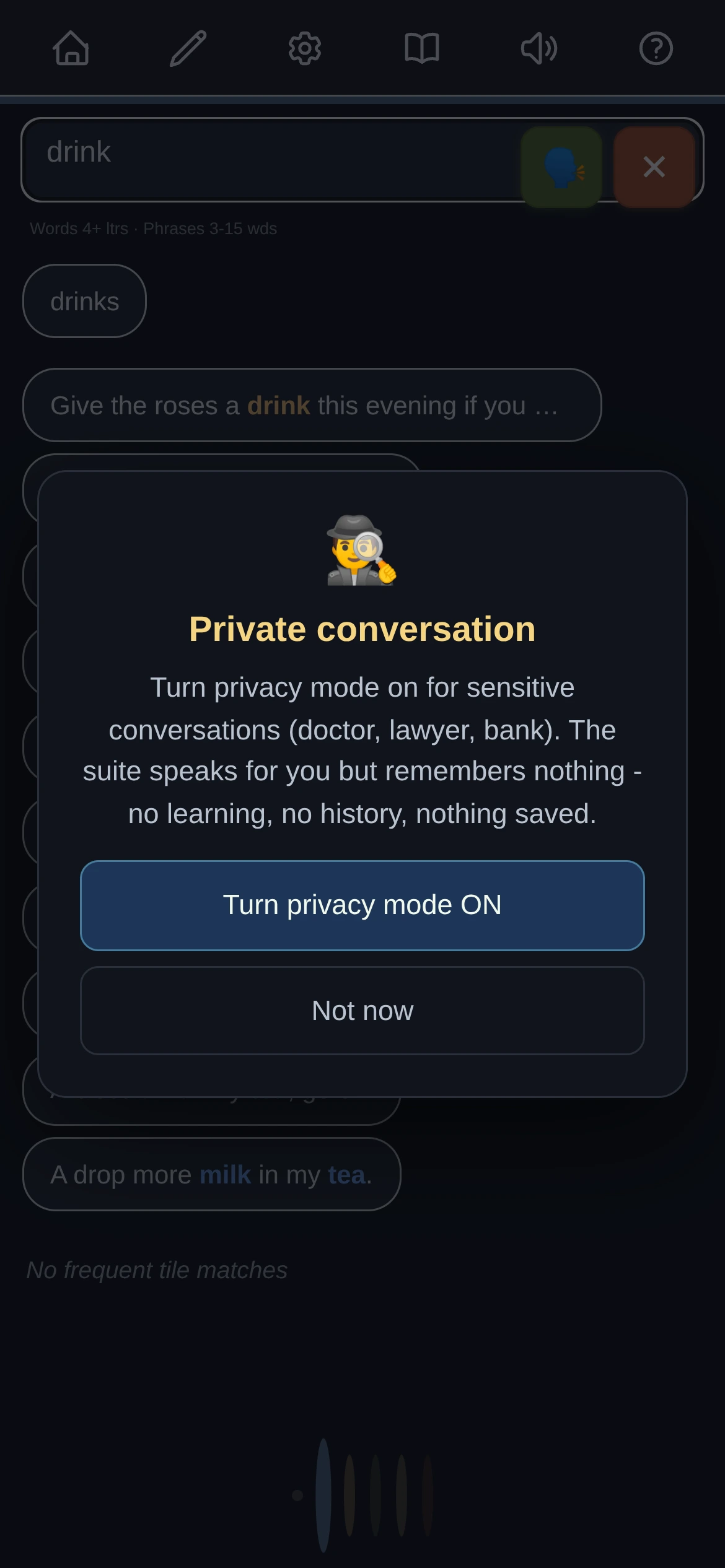
Your words stay yours. Everything you say is kept on your own device, never sent to the cloud, never shared. Then, when typing whole sentences gets harder, a few letters reach back into your own history and offer the thing you meant to say, ready to speak again in your voice. A coffee order. A joke you always tell. Something only for the person you love.
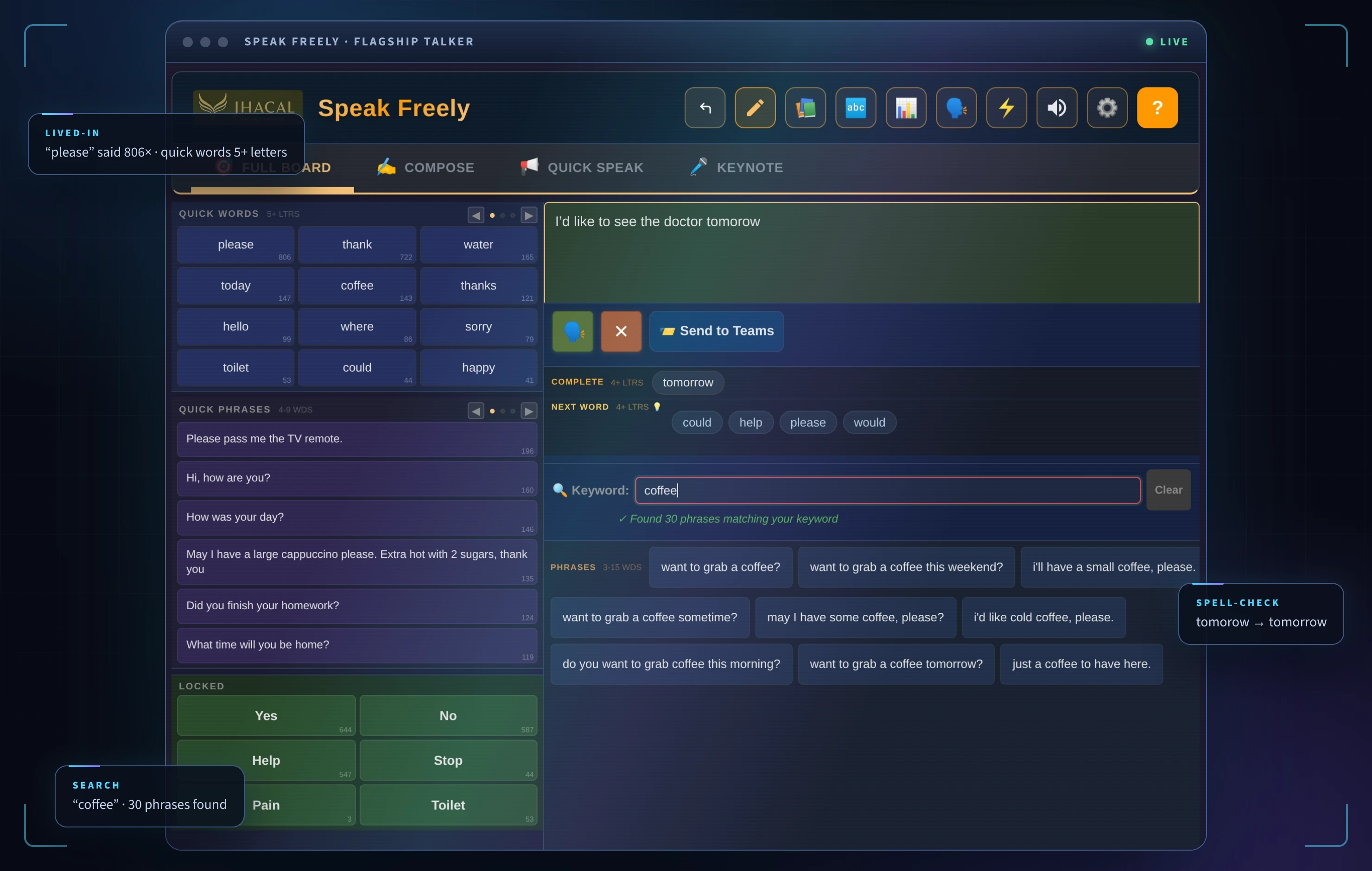
Speak Easy remembers every word and phrase, when you last said it and how often, so the things you say most sit closest to hand. A few letters, and it is you, saying it again.
Personalisation engine
Bank your own voice while you can, or build a clone of it, ElevenLabs-style, so what you type sounds like you. Cloning is strictly opt-in and consent-based: your recordings, your control, used for no one and nothing else.
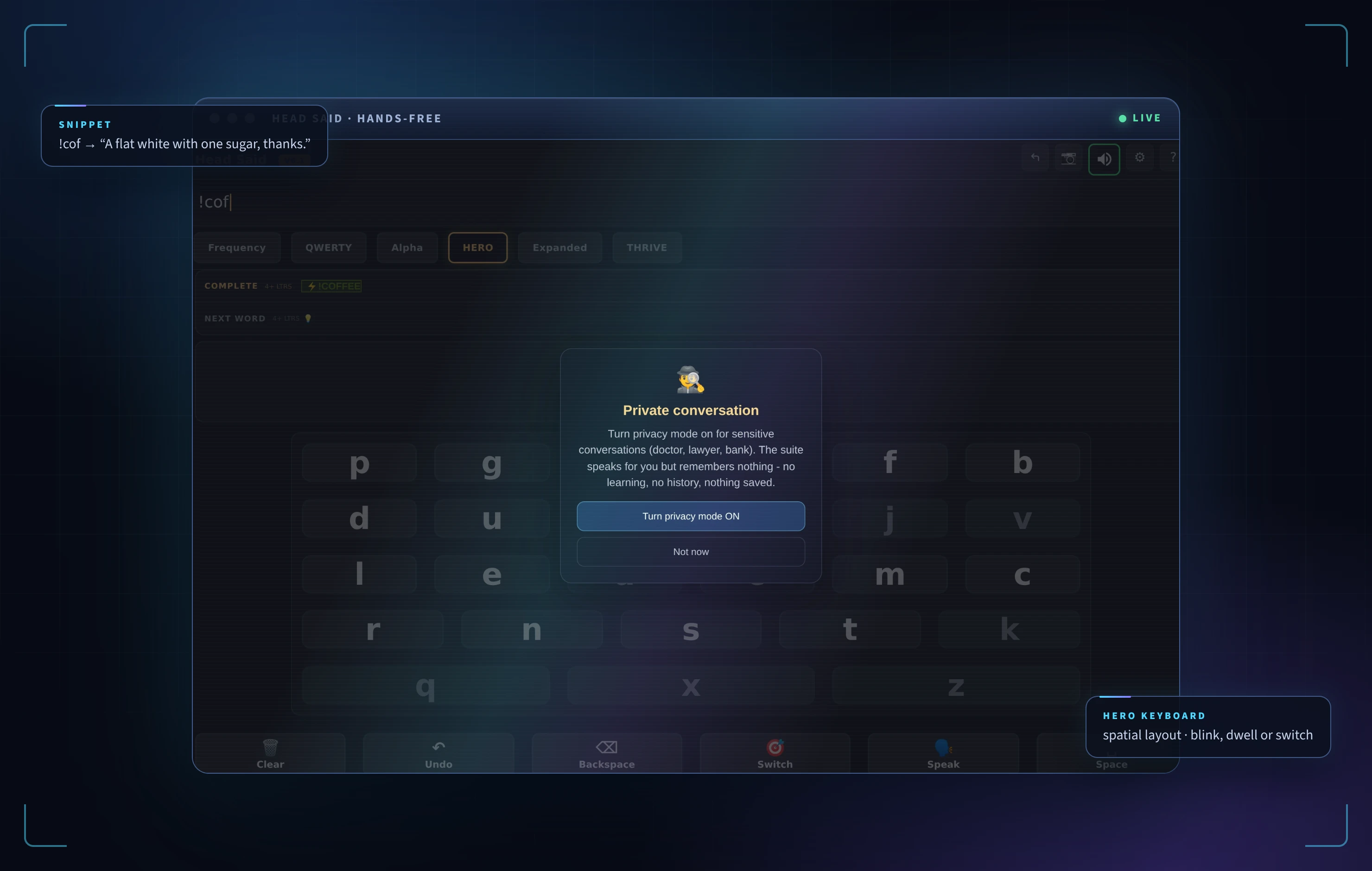
Touch, type, dwell, blink, head movement or a single switch. When movement changes, the input method changes with you. The vocabulary does not.
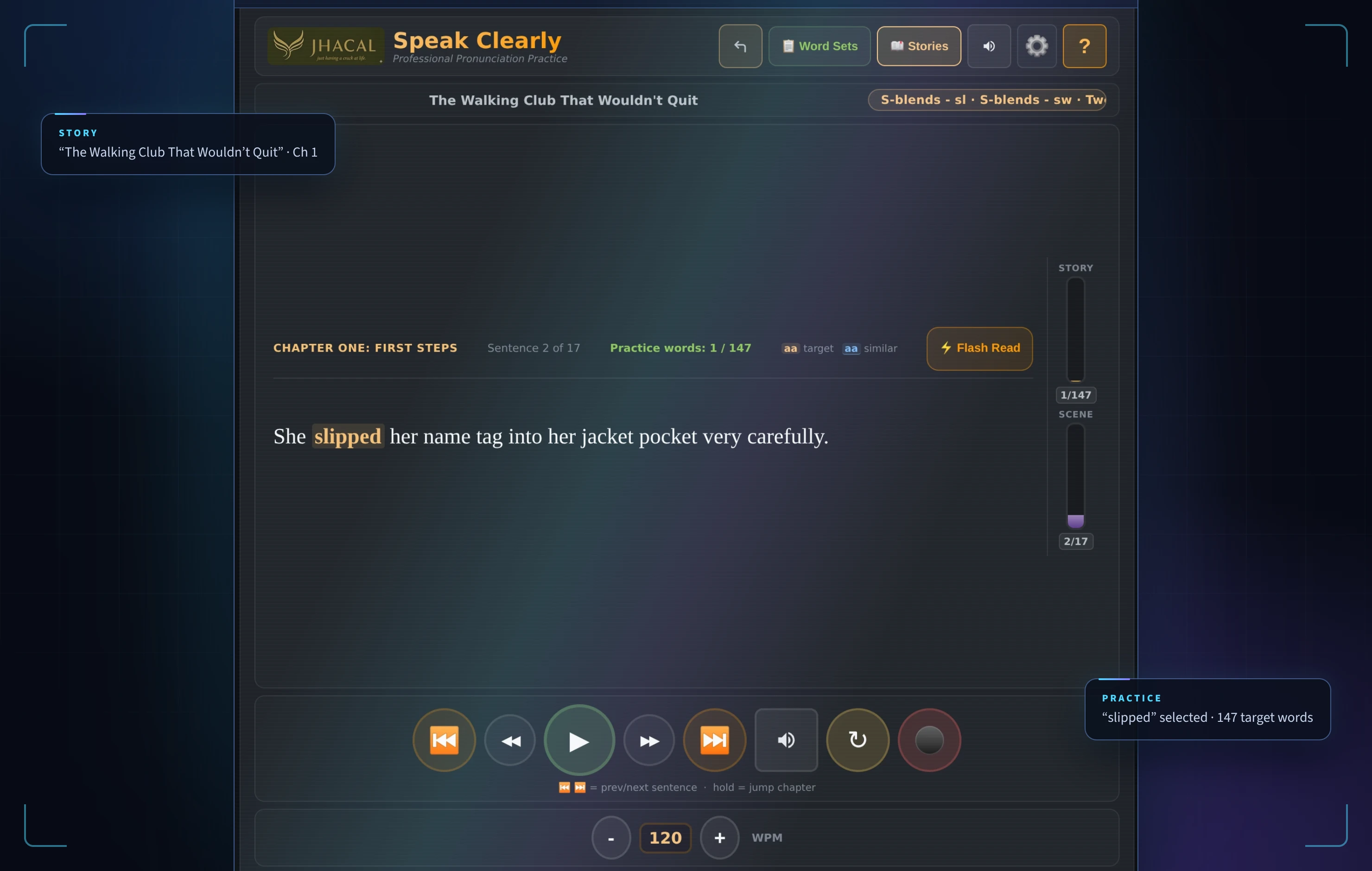
Rate, pitch, pauses and emphasis, adjusted until it sounds right to the people who know you. Practice tools help you keep your natural speech for longer.
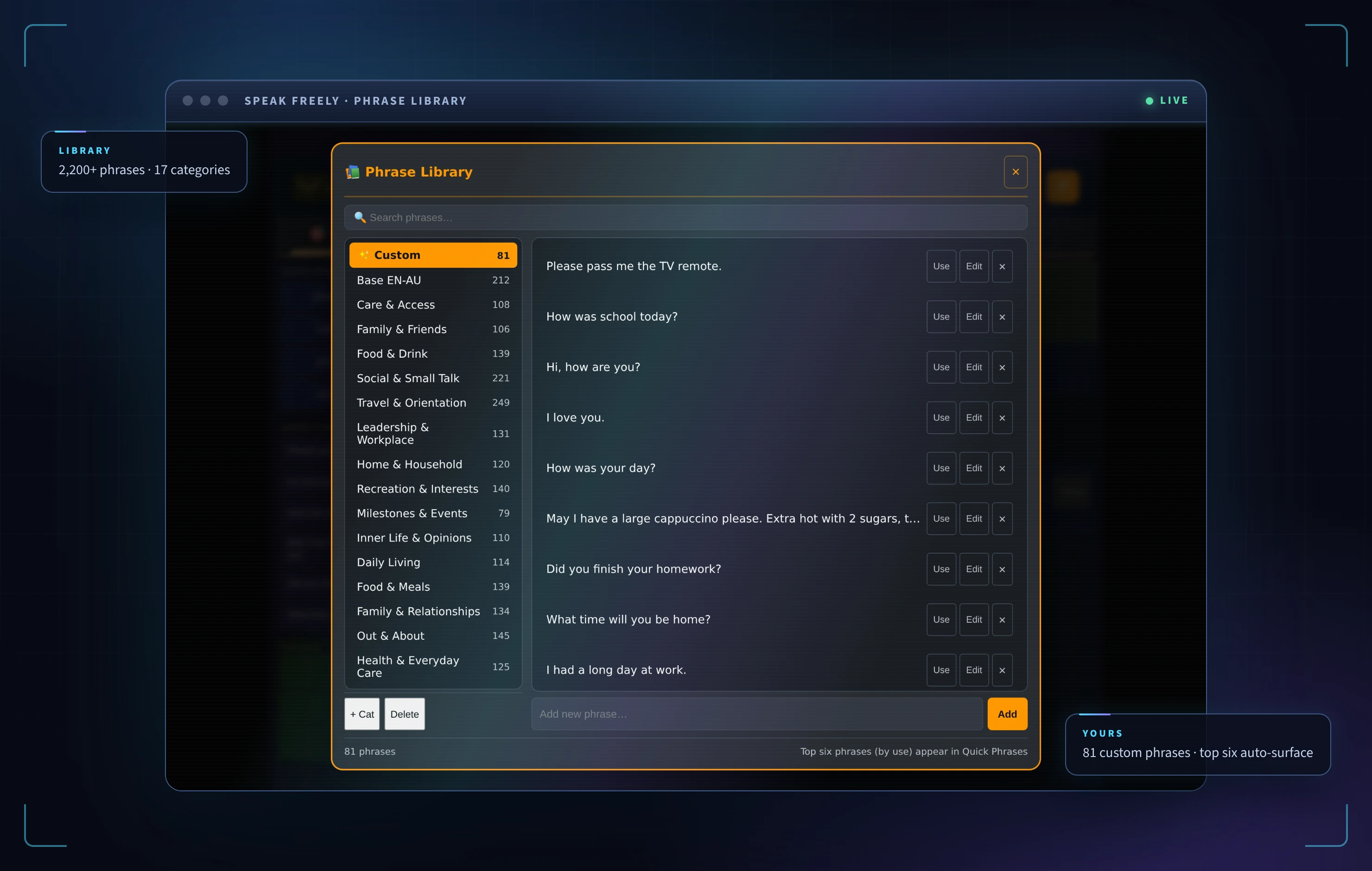
Quick words, locked essentials, snippets and topic boards that follow the shape of a real day. Your most-used lines auto-rank to the top.
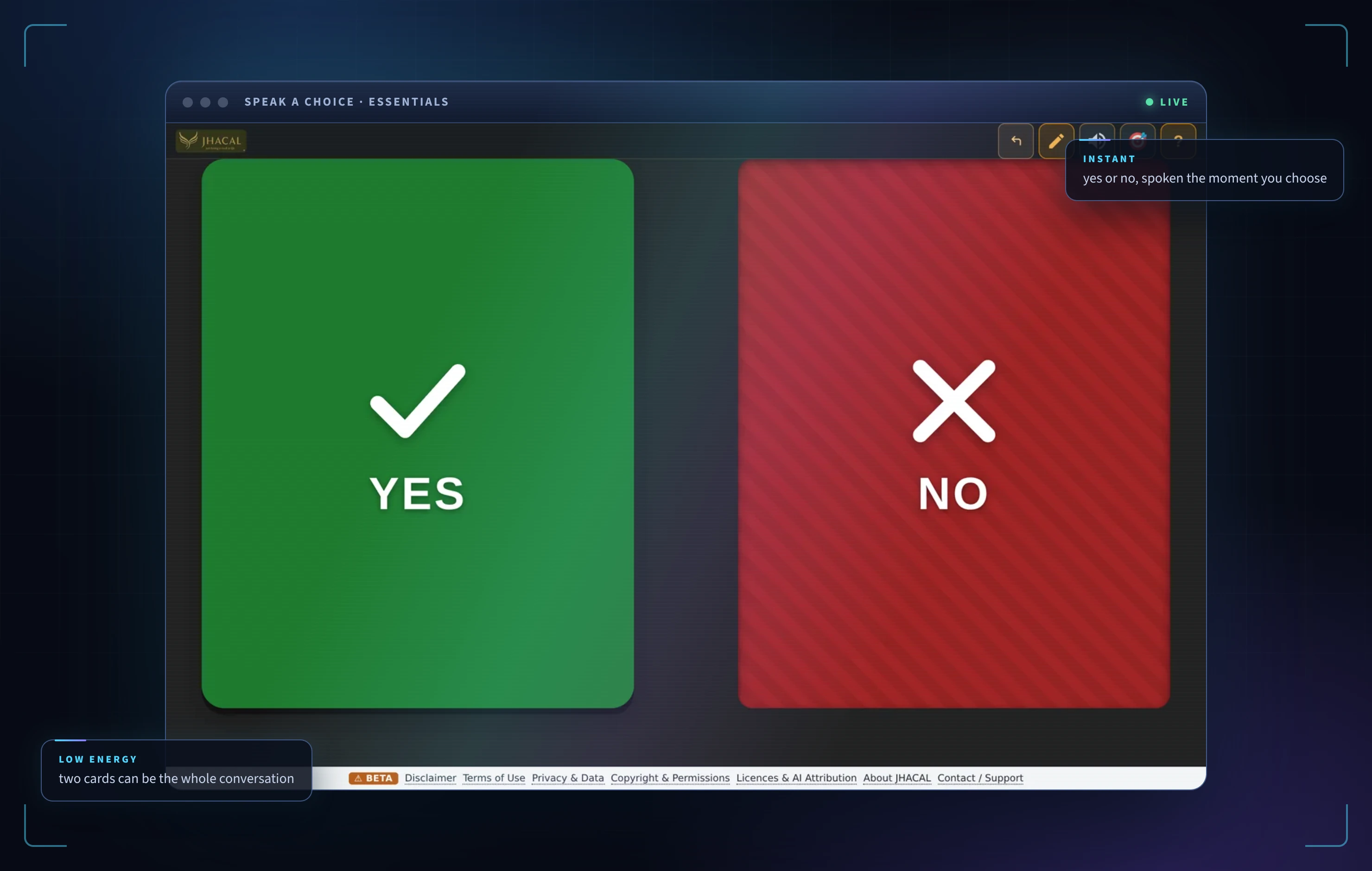
Bigger targets, fewer choices, calmer screens on low-energy days. From a full keyboard down to a single yes or no, without starting over.
Context-aware prediction and history recall build whole sentences from a few letters, so the words are ready before the moment passes.
Up close
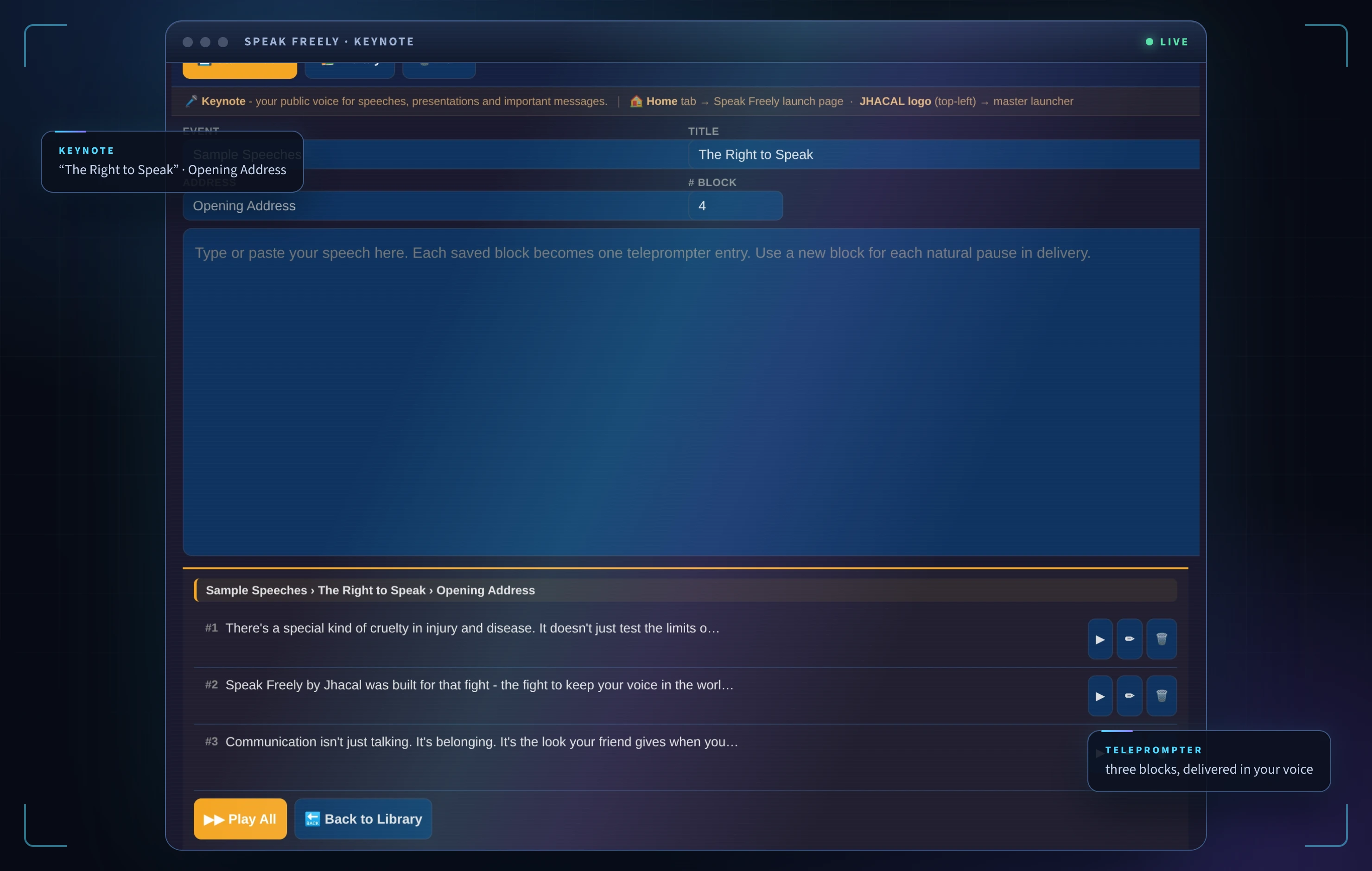
Straight from the suite, enhanced so you can see what each tool is doing the moment you need it.
Enterprise and team workflows
One person rarely communicates alone. Speak Easy Suite is built for the team around them: families, clinicians, classrooms and organisations.
Match the right tool to a hard Tuesday. Configure boards, vocabulary and access methods per client, and hand over a setup that just works.
Picture boards, choice cards and practice tools for the classroom, with layouts a support teacher can adjust in minutes, not meetings.
Keep colleagues in the conversation through vocal strain, recovery or long-term change. Quiet, fast and professional on any device already on the desk.
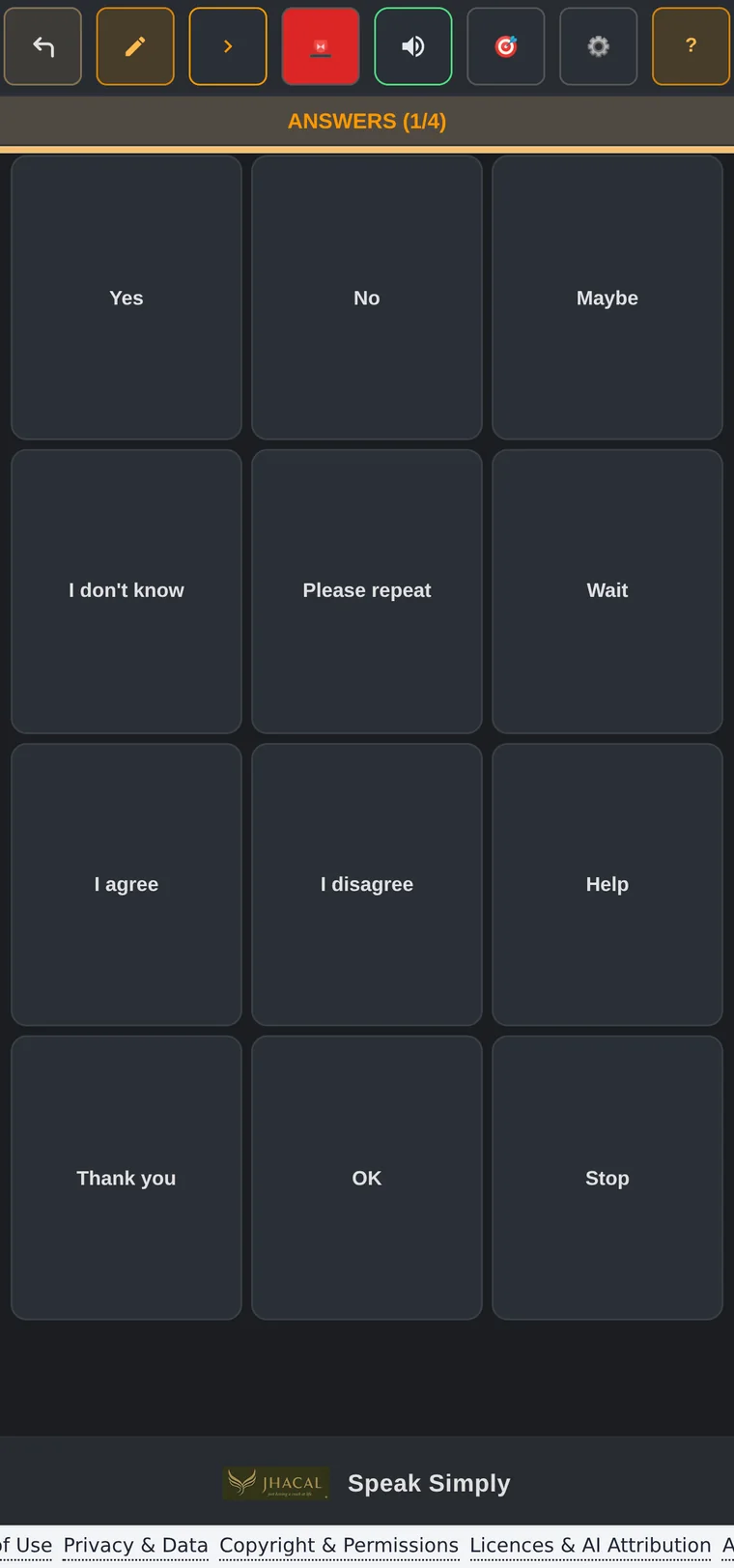
Carers set up before a shift and hand the device over. Locked essentials such as Yes, No, Help and Pain are always one tap away, including in emergencies.
Organisation licensing, device management and role-based settings, so the right people can configure and nobody can break what matters.
Accessibility-first design aligned with WCAG. No data capture, no tracking, nothing sold. Speech history lives on the user's device, which keeps governance simple.
Onboarding measured in minutes. No installs to push, no accounts to provision for the basics, and the same suite on desktop, tablet and phone. It passes from hand to hand without anyone reaching for a manual.
Use cases
Around 1 in 13 adults has a voice problem in any year. Order the coffee, run the meeting, read the bedtime story, all without spending a single word.
Singing is a known risk factor for voice disorders. Protect the instrument between shows and keep every conversation going at full volume.
About 1 in 10 patients has temporary voice changes after thyroid surgery, and up to 3 in 4 after prolonged intubation. A clear voice for the weeks your own is healing.
Teachers report voice disorders at nearly twice the general rate. Save your voice for the moments that need it and let the suite carry the rest.
Built first for a family member living with PSP, and for a workmate and friend living with MND. As speech, energy and movement change, the tools shift with you, and your banked voice stays yours.
Roughly 1 in 3 stroke survivors lives with aphasia. Picture boards, predictions and phrase recall lower the effort of every sentence.
Calm grids, consistent layouts and a vocabulary that grows with the person, at home, in class and everywhere in between.
When energy runs low, two large cards are enough: a green yes, a red no, spoken the instant you choose. Essentials stay locked on every screen.
Trust and evidence
"Every day in Australia, two people are diagnosed with MND and two people die from the disease."
MND Australia, echoed by FightMND's Fast Facts
An estimated 1.3% of Americans, around 4 million people, cannot reliably meet daily communication needs using natural speech, across conditions from stroke and autism to voice impairment and head and neck cancer.
US National Academies of Sciences, Engineering, and Medicine
Around 1 in 200 people may need augmentative and alternative communication, the estimate used to plan the UK's specialist AAC services.
Royal College of Speech and Language Therapists
Communication loss is not one story. It is temporary, like laryngitis, intubation recovery or surgery. It is situational, like vocal strain in teaching, childcare and performance, both recognised risk factors in voice research. And it is progressive or permanent, as with MND, Parkinson's, stroke and brain injury. Serious AAC has to serve all three, and it has to be ready before the hardest day, not after it.
Figures are rounded and current as at the publication date of each source. The organisations cited are independent of JHACAL: they have not reviewed, sponsored or endorsed Speak Easy Suite, and are referenced solely as the published sources of the statistics shown. This page is general information about communication need. It is not medical advice.
Communication is a right,
not a privilege.
Lifetime demo
The Speak Easy Suite demo is free for end users, for life. Register to receive updates and improvements as they ship. We will never ask for credit card or payment details. Not at signup, not later, not ever.
Start your free demo Corporate and association enquiries
Corporate, Association and other enquiries: speakeasysuite@outlook.com. We read every message ourselves; expect a real reply from a real person.